
Yes, you can lease used cars, but availability, vehicle age, mileage, and lender rules can limit your choices.
Can you lease used cars at a price that makes sense? In some cases, yes. Used car leasing can lower your monthly payment and help you drive a newer model without buying it outright. However, the contract, warranty, mileage limit, and end-of-lease costs need close review. This guide explains how used car leases work, where to find them, and when they are worth considering.

Can You Lease Used Cars?
Yes, you can lease used cars, but the process is less common than leasing a new vehicle. Most traditional leases start with new cars because lenders can predict their value more easily. Used car leases often involve certified pre-owned vehicles, dealer programs, or special financing companies.
When you lease a car, you pay for the value it loses during the lease term. You do not usually pay for the full vehicle. For example, if a car costs $30,000 and is expected to be worth $20,000 after three years, your payments are based mainly on that $10,000 loss, plus interest, taxes, and fees.
With a used car, the vehicle has already lost some value. That can reduce the amount you finance. Still, the lease may come with a higher interest rate or fewer protections than a new car lease.
If you are asking, “Can you lease used cars from any dealership?” the answer is no. Many dealers only lease new vehicles. Others may offer used car leases through a lender, especially for certified pre-owned models.
How Used Car Leasing Works
Used car leasing follows the same basic structure as a new car lease. The leasing company buys or owns the vehicle, then lets you use it for a fixed period. You make regular payments and return the vehicle at the end of the contract.
A used car lease usually includes these parts:
• Capitalized cost: This is the agreed value of the car at the start of the lease.
• Residual value: This is the estimated value of the vehicle at the end of the lease.
• Money factor: This is similar to an interest rate. A lower money factor usually means lower finance charges.
• Lease term: Most lease terms last 24, 36, or 39 months.
• Mileage allowance: Common limits include 10,000, 12,000, or 15,000 miles per year.
• Acquisition fee: This fee covers the lender’s cost to set up the lease.
• Disposition fee: Some companies charge this fee when you return the vehicle.
• Security deposit: Some lenders require a refundable deposit, although many do not.
Before signing, ask the dealer for the full lease worksheet. It should show the vehicle price, residual value, fees, taxes, monthly payment, and total amount due at signing.
Where Can You Lease Used Cars?
The answer to “Can you lease used cars?” often depends on where you shop. Used car leasing is more common through certain sellers than through large franchise dealers.
Certified Pre Owned Dealerships
Certified pre owned, or CPO, vehicles are inspected and may include an extended manufacturer warranty. Some automakers and dealers offer lease programs on CPO vehicles.
These leases can be easier to understand because the car has a clear service history. However, CPO vehicles may cost more than similar noncertified used cars.
Independent Dealers
Some independent dealers offer used car leases through third party finance companies. These contracts may be called leases, lease to own agreements, or purchase agreements with a final balloon payment.
Read the contract carefully. A lease to own deal may not work like a standard closed end lease. You may be responsible for buying the car at the end, and the total cost can be much higher than expected.
Online Car Retailers
Some online dealers advertise flexible payments on used vehicles. In many cases, these are loans rather than leases. Confirm the contract type before assuming you are leasing.
A true lease should explain the residual value, mileage rules, return process, and early termination terms. If those details are missing, you may be looking at a loan.
Specialty Leasing Companies
A few lenders specialize in leasing used luxury cars, electric vehicles, and premium SUVs. These companies may accept older vehicles than traditional lenders, but their rates and fees can vary widely.
Always check whether the company is licensed to operate in your state. State consumer protection agencies and financial regulators can help you verify a lender.
What Used Cars Can You Lease?
Not every used car qualifies for a lease. Lenders usually prefer vehicles with stable resale values and reliable demand.
You may have better luck leasing:
• Certified pre owned cars
• Recent model year vehicles
• Luxury cars with strong resale values
• Electric vehicles with clear battery warranties
• Cars with low mileage
• Vehicles with complete service records
Many lenders set age and mileage limits. For example, a lender may reject a car that is more than four years old or has more than 50,000 miles. These limits differ by company, so ask before you apply.
The car’s warranty also matters. A used vehicle may need coverage during the full lease term. If the original warranty expires soon, you could face repair costs that make the lease less attractive.
Benefits of Leasing a Used Car
Used car leasing can offer several benefits when the contract is fair and the vehicle is in good condition.
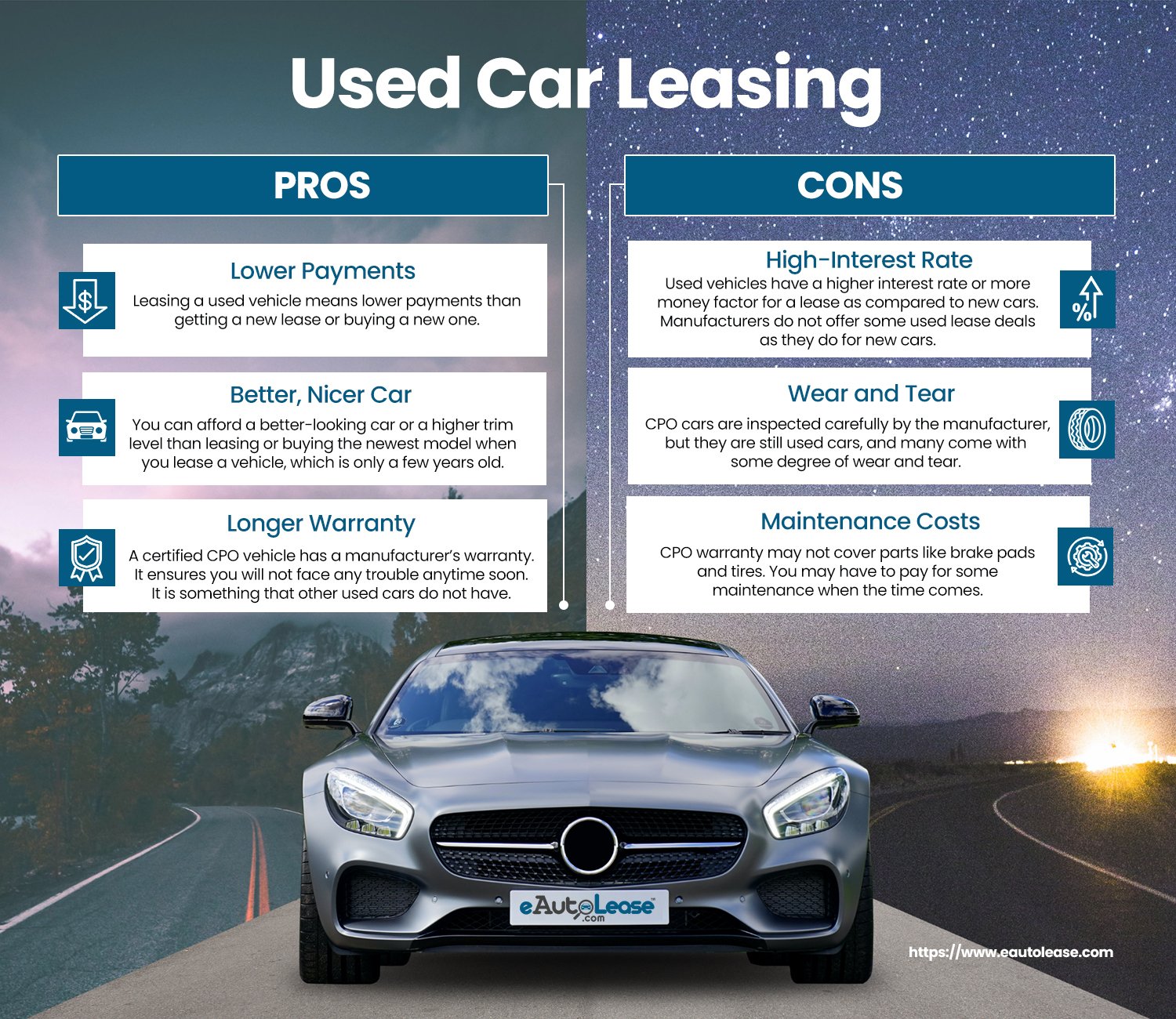
Lower Monthly Payments
A used car may have a lower selling price than a new car. That can reduce your monthly payment. However, do not assume every used lease is cheaper. A high money factor or low residual value can erase the savings.
Access to Better Models
Leasing a used luxury sedan or SUV may cost less than buying the same vehicle new. This can give you access to features, safety systems, and comfort upgrades that would otherwise exceed your budget.
Shorter Commitment
A lease lets you use the car for a set term without committing to long term ownership. This may help if you expect your needs to change soon.
Possible Warranty Coverage
A newer used car may still have factory warranty coverage. A CPO vehicle may include additional protection. This can reduce the risk of major repair bills during the lease.
Lower Upfront Cost in Some Cases
Some used leases require a smaller down payment than a traditional purchase. Still, putting down a large amount is risky because you may lose that money if the vehicle is stolen or totaled.
Drawbacks of Leasing Used Cars
The answer to “Can you lease used cars?” is yes, but that does not mean leasing is always the best choice.
Limited Availability
Used car leases are not offered everywhere. You may need to search several dealers or contact lenders directly.
Higher Interest Charges
Used vehicle leases may have higher money factors than new car leases. The lender sees more risk because the vehicle is older and may have less predictable repair costs.
Mileage Limits
Most leases limit how far you can drive. Extra mileage charges often range from about 15 to 30 cents per mile, but your contract controls the exact amount.
Driving 5,000 miles over your limit could therefore cost $750 to $1,500. Estimate your yearly driving before you sign.
Wear and Use Fees
You may owe money for damage beyond normal wear. Examples include large dents, cracked glass, damaged wheels, stained seats, and missing equipment.
Ask for the lender’s inspection guide. Take clear photos of the car when you receive it and when you return it.
No Ownership
Lease payments build no equity. At the end of the term, you return the car unless your contract includes a purchase option.
Early Termination Costs
Ending a lease early can be expensive. The lender may charge remaining payments, an early termination fee, or the difference between the car’s value and the lease balance.
If you may move, change jobs, or need a larger vehicle soon, buying may offer more flexibility.
Used Car Lease Versus Used Car Loan
A used car loan and a used car lease serve different goals. A loan helps you become the owner. A lease gives you the right to use the vehicle for a set period.
| Factor | Used car lease | Used car loan |
|---|---|---|
| Ownership | Lender owns the car during the lease | You own the car after paying the loan |
| Monthly payment | Often based on depreciation | Based on the full amount borrowed |
| Mileage limit | Usually applies | No lease mileage limit |
| End of term | Return or buy the car | Keep the car |
| Equity | Usually none | Builds as you repay |
| Repairs | May be covered by warranty | Usually your responsibility |
| Flexibility | Limited by contract | Easier to sell or modify |
A lease may suit you if you want a newer car every few years and drive predictable miles. A loan may suit you if you drive a lot, want long term value, or plan to keep the car after it is paid off.
One practical lesson is easy to remember: compare total cost, not just the monthly payment. A low payment can hide a large amount due at signing, high fees, or an expensive buyout.
How to Find a Good Used Car Lease
Use a careful process before agreeing to any deal.
1. Set Your Driving Budget
Add the monthly payment, insurance, fuel, maintenance, registration, taxes, and parking. Also set aside money for unexpected costs.
2. Check the Vehicle History
Review the vehicle identification number, or VIN. Look for accident records, title problems, flood damage, odometer issues, and repeated repairs.
A clean history report is useful, but it is not a guarantee. Have an independent mechanic inspect the car before you sign.
3. Confirm the Warranty
Find out what the warranty covers, when it ends, and whether it transfers to you. Ask about the engine, transmission, electronics, battery, roadside service, and rental car coverage.
4. Compare the Lease Terms
Request written details for:
• Selling price
• Residual value
• Money factor
• Total fees
• Mileage allowance
• Amount due at signing
• End of lease charges
• Purchase option price
5. Get Insurance Quotes
Leased cars often require comprehensive and collision coverage. Some lenders also require specific liability limits. Insurance costs can be higher for luxury models and older vehicles with expensive parts.
6. Negotiate the Vehicle Price
You can often negotiate the vehicle’s selling price before discussing the monthly payment. A lower starting price usually improves the lease cost.
7. Avoid Unnecessary Add Ons
Dealers may offer paint protection, fabric coverage, wheel protection, service plans, and other products. Some may be useful, but many increase the lease cost without adding much value.
Lease Terms You Should Understand
Lease language can feel like a maze. These terms make the path clearer.
Residual Value
Residual value is the lender’s estimate of what the car will be worth when the lease ends. A higher residual value usually lowers the depreciation portion of your payment.
Used cars can have less predictable residual values. That is one reason lenders may use stricter rules or higher charges.
Money Factor
To estimate a rough interest rate, multiply the money factor by 2,400. For example, a money factor of 0.00250 equals an estimated annual percentage rate of about 6 percent.
Ask whether the money factor is negotiable. Some dealers add a markup to the lender’s base rate.
Adjusted Capitalized Cost
This is the amount used to calculate your payment after adding fees and subtracting discounts, trade in credits, or rebates.
A large down payment can lower the adjusted capitalized cost. However, it does not reduce the risk of losing money after a total loss.
Purchase Option
The purchase option is the amount you may pay to buy the vehicle at the end of the lease. Add any purchase option fee and taxes to this amount.
Compare the buyout price with the car’s market value. Buying the vehicle only makes sense if the price and condition are favorable.
Common Mistakes to Avoid
When people ask, “Can you lease used cars?” they often focus only on approval and monthly payments. The contract details matter just as much.
Avoid these mistakes:
• Accepting a lease without seeing the full calculation
• Ignoring the vehicle’s accident and maintenance history
• Choosing a mileage limit that is too low
• Paying a large down payment
• Skipping an independent inspection
• Assuming all repairs are covered
• Confusing a lease to own deal with a standard lease
• Failing to ask about early termination
• Forgetting taxes, registration, and insurance
• Signing before comparing the lease with a loan
A useful habit is to take the contract home. A trustworthy dealer should give you time to read it. If someone pressures you to sign immediately, treat that as a warning sign.
Is Leasing a Used Car Right for You?
Used car leasing may work well if:
• You want a newer used car
• You drive a predictable number of miles
• You prefer lower short term payments
• You want to change vehicles every few years
• The vehicle has strong warranty coverage
Buying may be better if:
• You drive more than 15,000 miles per year
• You want to keep the car for many years
• You want to build equity
• You need freedom to sell or modify the vehicle
• You dislike return inspections and lease rules
There is no universal answer to “Can you lease used cars?” that fits every driver. Your mileage, credit, budget, repair risk, and ownership goals all matter.

Frequently Asked Questions About Leasing Used Cars
Can you lease used cars from a regular dealership?
Yes, some regular dealerships offer leases on certified pre owned or recent model year vehicles. Many dealerships do not, so ask which lenders support used vehicle leasing before you visit.
Is leasing a used car cheaper than buying one?
It can be cheaper each month, but not always cheaper overall. Compare the total lease payments, fees, down payment, insurance, and possible buyout price with the total cost of a used car loan.
Can you lease used cars with bad credit?
Approval may be possible, but bad credit often leads to higher finance charges, larger deposits, or stricter vehicle rules. Review the total cost carefully and consider improving your credit before applying.
Can you lease a used car with high mileage?
Some lenders allow high mileage, but many set limits on the car’s age and mileage. A vehicle with high mileage may also have a higher payment or may qualify only through a specialty lender.
Can you buy a used leased car at the end of the contract?
Usually, yes, if the lease includes a purchase option. Check the contract for the buyout amount, purchase fee, taxes, and any inspection requirements before making your decision.
Do used car leases include warranties?
Some do, especially leases on certified pre owned cars. Warranty coverage varies, so confirm the exact parts, time period, mileage limit, and repair process in writing.
Conclusion
Can you lease used cars? Yes, but used car leasing is less common and often requires more research than a new car lease. Look for a recent, well maintained vehicle with clear history, strong warranty coverage, fair mileage terms, and transparent fees.
Compare the full cost with a used car loan. Review the contract, inspect the vehicle, and avoid making a large down payment. With careful planning, you can find a used car lease that fits your needs rather than chasing a payment that only looks cheap.
Start by contacting several dealers and lenders, request written quotes, and compare every fee before signing. Share your questions or leasing experience in the comments, and explore more vehicle buying guides before making your next move.